
Uncompromising Agriculture: How PasiSera Is Redefining Greenhouse Production
Traditional agriculture operates in a fragile balance. Production depends on seasons, costs are driven by energy and resource prices, and yields can vary significantly from one cycle to the next. For most growers, these variables mean constant risk and limited predictability.
In this context, modern greenhouses are no longer simply protected spaces for crops. They are becoming controlled production environments where every environmental factor can be measured, managed, and optimized.
PasiSera starts from exactly this need: better control, lower costs, and stable production throughout the entire year.
From Seasonal Agriculture to Continuous Production
One of the biggest limitations of conventional agriculture is its dependence on seasons. Temperature swings, climate variability, and external conditions directly affect the final result, and there is very little a grower can do about it.
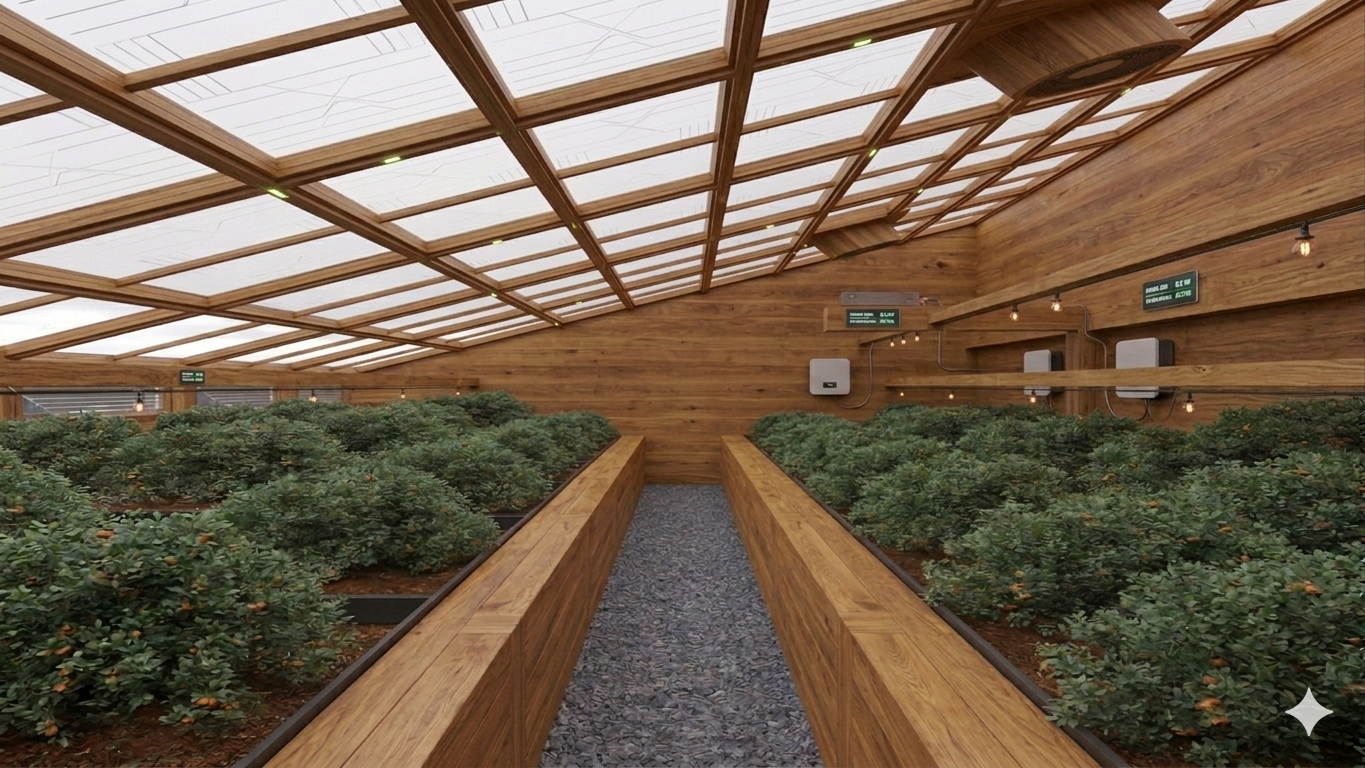
PasiSera addresses this through passive greenhouse design, including walipini-style subterranean structures that use the earth itself as a natural insulator. Soil maintains more stable temperatures year-round, significantly reducing the energy required for heating and cooling.
The result is not just efficiency, it is consistency. Crops that can be managed, optimized, and harvested on a predictable schedule regardless of what is happening outside.
Environmental Control: The Difference Between Yield and Uncertainty
In a traditional greenhouse, many critical factors remain difficult to control. In a PasiSera system, those same factors become measurable and adjustable.
Temperature, humidity, and other key variables are continuously monitored and integrated into a system that enables faster, more precise decisions. This approach reduces losses and increases yield without a proportional increase in resource consumption.
Control does not mean unnecessary complexity. It means the elimination of uncertainty.
Energy Independence and Operational Resilience
Energy costs are one of the most significant challenges in protected agriculture. Conventional greenhouse systems depend heavily on external energy sources, making them vulnerable to price volatility and supply disruptions.
Through passive design and the integration of renewable energy solutions, PasiSera reduces this dependency. This is not sustainability as a concept; it is a more stable and efficient economic model that protects margins regardless of what energy markets do.
From Components to System
One of the fundamental differences between traditional approaches and PasiSera is integration. Instead of a separate solutions structure, seeds, irrigation, and climate control, PasiSera builds a system where all of these elements work together as a single unit.
This integration enables real optimization, not just isolated improvements. When the structure, the monitoring layer, and the control system are designed to work together, the whole performs better than the sum of its parts.
The Future of Agriculture: Predictable, Scalable, Controlled
As pressure on resources increases and demand for consistent production grows, traditional models are becoming insufficient. The agricultural systems that will define the next decade are those that can deliver control, efficiency, and scalability not just in ideal conditions, but in any conditions.
PasiSera positions itself exactly at this point: not as a supplier of components, but as a complete solution for more predictable, more resilient, and more profitable agriculture.
The gambling era of farming is over. What comes next is built, monitored, and optimized from the ground up.